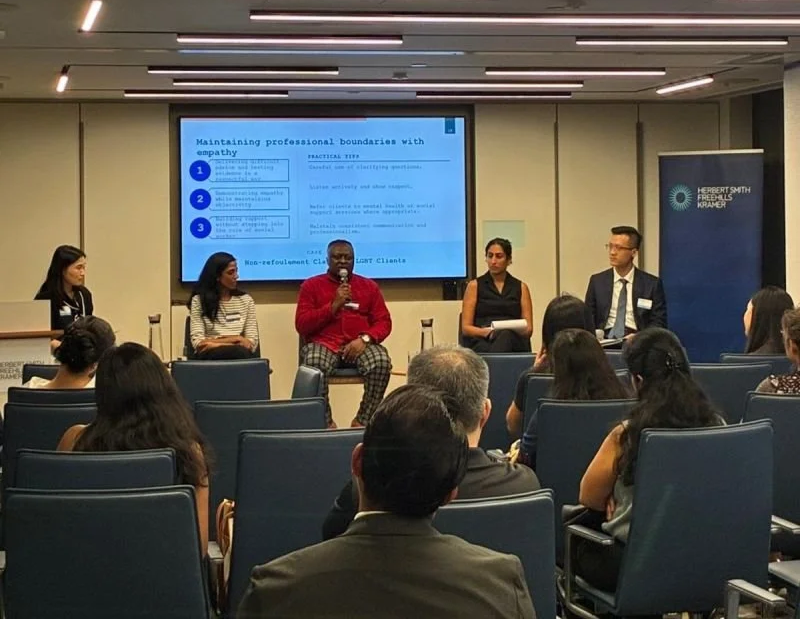
Asylum Services & Knowledge (ASK) and Herbert Smith Freehills Kramer (HSFK) co-hosted a session on Best Practices for Trauma-Informed Lawyering. The session brought together lawyers, mental health professionals and community members, and marked the launch of a new discussion paper prepared by ASK and HSFK.
We are pleased to announce the release of new practice resources for legal professionals: Trust, Trauma and the Law: Community Voices on Refugee Lawyering in Hong Kong (the “Discussion Paper”), and its accompanying Practice Guidelines for Trauma-Informed Refugee Lawyering. (the “Practice Guidelines”). Both resources can be accessed here.
Produced in partnership with Herbert Smith Freehill Kramer (HSFK) and refugees and asylum seekers in Hong Kong, these resources aim to enhance the overall quality of legal services provided to people seeking non-refoulement protection in Hong Kong as they navigate complex, and often life-altering, legal processes. In centering the voices and lived experiences of refugees and people seeking protection, we recognise these groups as experts in their own interactions with the legal system and as essential guides to understanding how representation can be improved to better meet their needs.
The Discussion Paper comprises three interrelated elements. First, a thematic analysis that captures the voices and experiences of refugees and people seeking protection who shared with us their lived experience of working with lawyers to process their protection applications in Hong Kong. Second, a set of guidelines for lawyers to improve the delivery of legal services to refugees and people seeking protection, informed by both the thematic analysis and international best practice principles for trauma-informed lawyering. Third, a series of practical steps and recommendations for lawyers to implement. The guidelines and practical tips separately form the Practice Guidelines for easy reference.
The Discussion Paper and Practice Guidelines are categorised into six primary principles:
• Principle 1: Building a relationship of trust and safety;
• Principle 2: Active Representation;
• Principle 3: Exercising care and empathy while balancing professional boundaries;
• Principle 4: Being aware of and making accommodations for the effects of trauma and ongoing stressors;
• Principle 5: Understanding the client’s social and cultural background; and
• Principle 6: Working effectively with interpreters.
Refugees and people seeking protection face a range of complex and interconnecting challenges when engaging with legal processes. These challenges include mistrust in legal staff and decision-making bodies, cultural and linguistic barriers, and inaccessible information about refugee law and the required steps to seek protection. Importantly, these challenges are exacerbated by the compounding impacts of trauma experienced in their country of origin and during each subsequent stage of migration. In identifying these intersecting challenges, these resources help lawyers shape their practices to be client-centred, trauma-informed, and culturally competent.
While these resources were developed in the context of non-refoulement claims in Hong Kong, many of its principles and recommendations are equally applicable to lawyers working with other client groups who may face significant challenges when engaging with legal systems.
On 2 September 2026, ASK and HSFK co-hosted a CPD-accredited training session for lawyers and community legal service providers on Best Practices for Trauma-Informed Lawyering, where the resources were launched. On 24 September, we spoke alongside Tim Parker SC of Temple Chambers and refugee expert Joseph Bong to a packed room of barristers. Our Senior Advisor / Clinical Psychologist Dr Steven Livingstone discussed trauma across the migration journey and how it may manifest in the course of the lawyer-client relationship; while our Legal Director Kaavya Viswanathan shared insights from ASK’s legal team and the Discussion Paper.
We have partnered with Equal Justice and Pro Bono Hong Kong to deliver training on trauma-informed lawyering, to support lawyers who are doing good in the community. Interested in hosting a session or collaborating on developing trauma-informed, community-centred legal practices? Please do not hesitate to reach out to us at info@ask.org.hk.